
Sunday 6th March 2022
Last night was terrible. Madeline managed to have 3 night terrors needing supervision. Along with 3 hour feeds for Charlotte we got little sleep. Aunty Bec slept through a lot of it luckily.
We spent the day at the van enjoying the cool breeze. It was a top of 32 here today with constant SE winds making hanging outside amazing. It was the first time we could sit outside at lunchtime and enjoy ourselves.
It was a cool 23 with a SE wind this morning. Madeline has to acclimatise to the cooler weather.

We had pancakes as part of a fundraiser for the RFDS this morning.
We played at the games room a little as well.

Aunty Bec took Madeline swimming this morning as well.

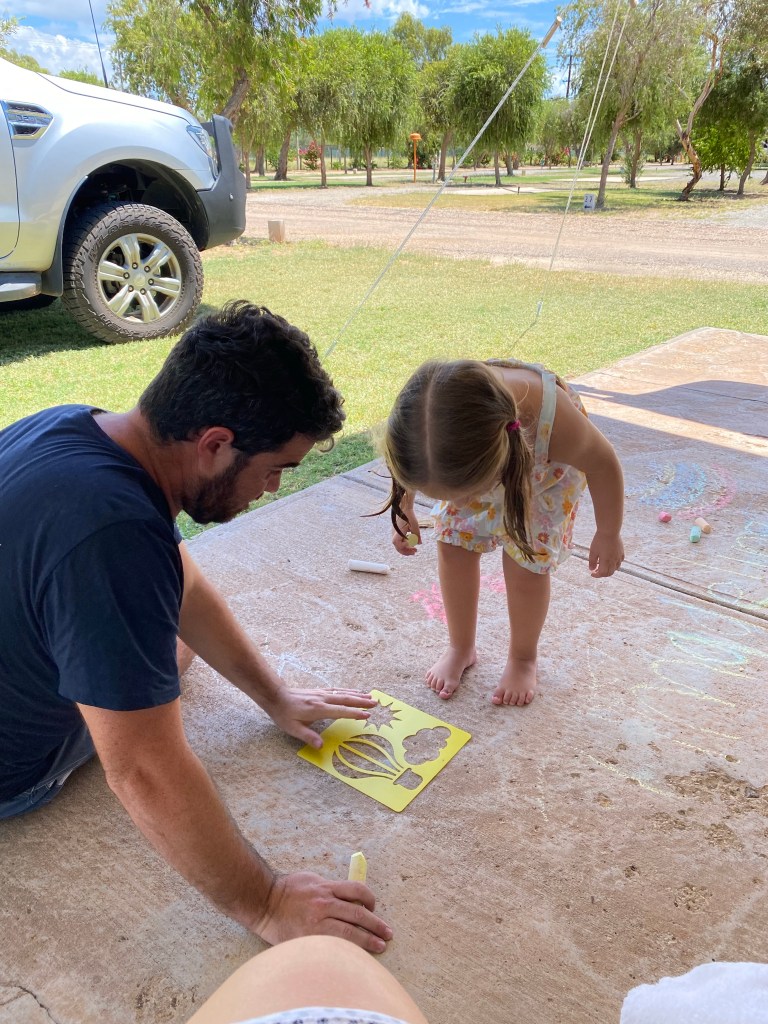
We did some chalk play after lunch.
Daddy had some relaxing one on one time with Charlotte.
We had a great day relaxing at the caravan.
Alice Springs
Alice Springs was original known as Stuart until 31 August 1933, when the name Alice Springs was given by surveyor William Whitfield Mills after Alice, Lady Todd (née Alice Gillam Bell), wife of the telegraph pioneer Sir Charles Todd.
Known colloquially as The Alice or simply Alice, the town is situated roughly in Australia’s geographic centre. It is nearly equidistant from Adelaide and Darwin.
The area is known as Mparntwe to its original inhabitants, the Arrernte, who have lived in the Central Australian desert in and around what is now Alice Springs for tens of thousands of years.
The town straddles the usually dry Todd River on the northern side of the MacDonnell Ranges. The surrounding region is known as Central Australia, or the Red Centre, an arid environment consisting of several deserts.
History
It was not until alluvial gold was discovered at Arltunga, 100 kilometreseast of the present Alice Springs, in 1887 that any significant European settlement occurred.
The town’s first substantial building was the Stuart Town Gaol in Parson’s Street; this was built in 1909, when the town had a European population of fewer than 20 people. Many of the gaol’s first prisoners were first-contact aboriginal men incarcerated for killing cattle.
Most building were erected around WWII. Before this Alice had a populist around 500 people. By the end of WWII 200,000 people would have visited Alice. It was an important stop over on the long trip to Darwin.
Alice Springs was connected to Darwin by rail on 4 February 2004, when the first passenger train arrived in Darwin from Adelaide.
The town’s population, 26,534 in June 2018, accounts for approximately 10 per cent of the population of the Northern Territory.
Tomorrow
Aunty Bec goes on a day trip to Uluṟu. We will be hanging out in Alice Springs.

 morrisblog.travel.blog