
Monday 28th February 2022
So we had an ok night. It was warm, but we figured out how to stay cool.
Madeline had another night terror but it wasn’t nearly are long or savage as the night before.
We got up and got ourselves and the caravan prepped for leaving. We left Nitmiluk Campground and headed to Katherine town. we filled up our gas bottle and went grocery shopping.
Due to Eva’s midnight feed web browsing we had a change of plans. Katherine through to at least Tennant Creek was supposed to be 40 degrees up until a change at around 830pm. We made a decision to pay for a powered campsite on the highway.
Larrimah Pink Panther Hotel was our chosen destination.
We passed through Mataranka again where we had lunch and then continued on our journey down the Stuart Highway.
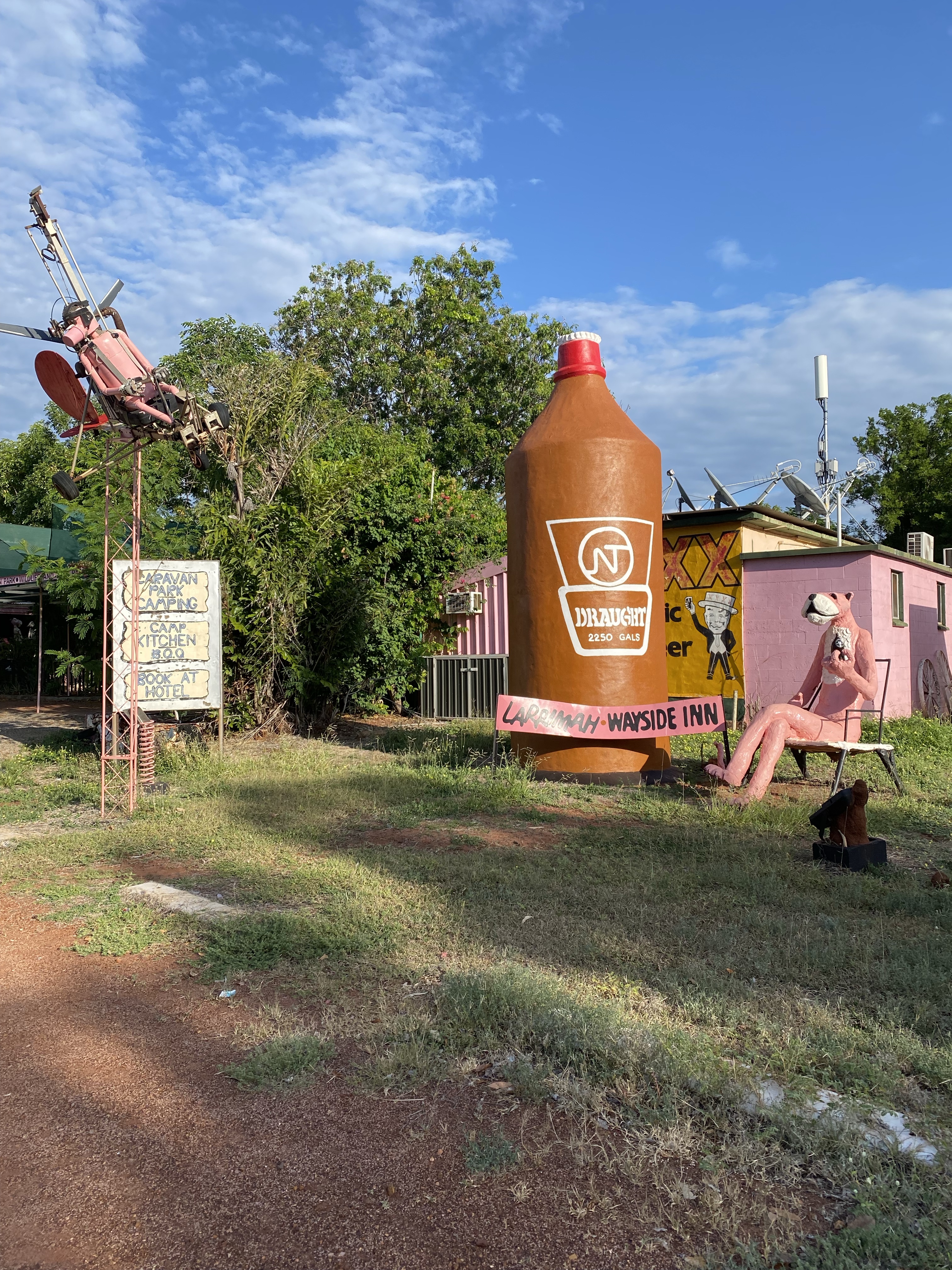
We arrived in Larrimah around 1pm and checked in. It a one horse town, red dust, very run down. The single pub in the town was where the van park was. The pub was close to derelict as were the campgrounds, but we’ve seen worse. A powered site is a powered site.
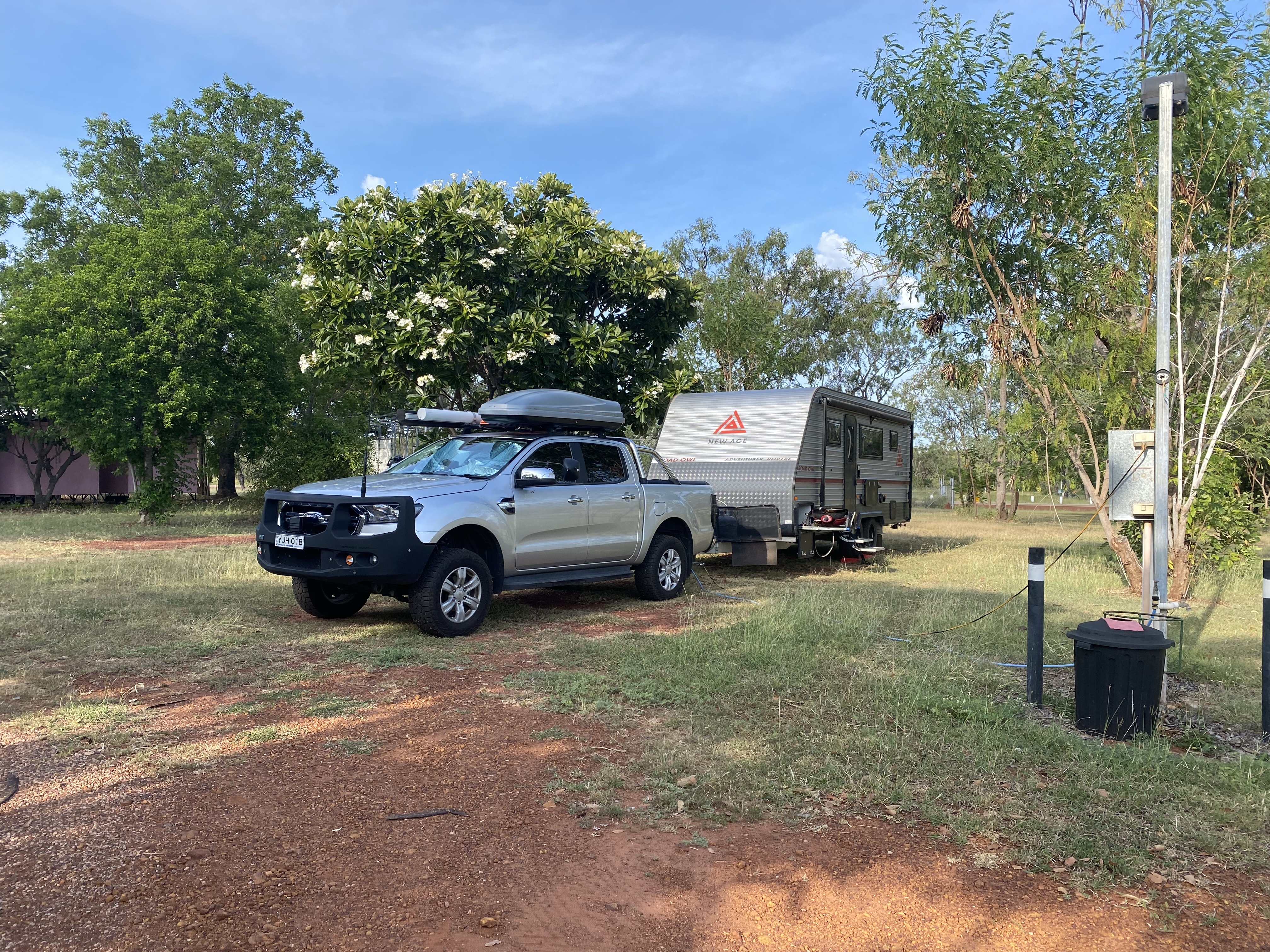
We spent the afternoon in the caravan aircon which struggled to get below 34 degrees inside until it hit sundown. We were grateful for the aircon particularly for baby Charlotte.

We made chicken schnitzel for dinner and then put the girls to sleep. We didn’t stay up much longer either.
Larrimah
Larrimah is located 184 metres above sea level on the Stuart Highway. It is 498 km south of Darwin, 182 km south-east of Katherine and 999 km north of Alice Springs.
The Northern Territory place names register records that no information is known about the origin of the name. It has been suggested that it means “meeting place” in the Yangman Aboriginal language.
Prior to the arrival of Europeans the area had been occupied for over 40,000 years by the Yangman Aboriginal people.
In 1889 the North Australian railway line from Darwin, known by the locals as ‘the line to nowhere’, reached Larrimah which was 8 km to the north of the real terminus at Birdum.
Larrimah was established in March 1941 as a “village” during World War II. The 8th Australian Staging Camp, built by the Australian Army, was set up for troops making the journey by road from Adelaide before transferring onto rail at Larrimah siding for the rest of the journey to Darwin. No. 45 Australian Camp Hospital was also set up at Larrimah by the Australian Army. The town then served as a railhead until the line closed in 1976.
The town’s pub, the Pink Panther, was originally 9 km south in Birdum, but was moved when Larrimah became the end of the railway. It is the home of the Big Stubby, a large replica of a Darwin Stubby beer bottle.
In 1998, it received a National Tidy Towns award. Larrimah’s fuel station burnt down in October 2009 so no fuel is available there.
There is a Northern Territory Fire and Rescue Service unit stationed there to attend motor vehicle accidents and local bush and grass fires.
On the north end of town is Fran’s Devonshire Tea House. Fran’s is the location of Larrimah’s old police station, and uses the original bars and windows of the jail cells. The shop is the tracker’s quarters and courthouse.
Overland Telegraph
We were originally going to stay at a Rest Area named after Alexander Forrest. His story is quite interesting. The rest area is near the location his expedition of 1879 met the Telegraph Line.
As a government surveyor, Forrest explored many areas of remote Western Australia, particularly the Kimberley region. Several of his expeditions were conducted alongside his brother, John Forrest, who became the first Premier of Western Australia.
In 1870, a party of six men including Alexander and his brother John left Perth. Five months later they reached Adelaide.
In 1874, Alexander was part of another party again including brother John which took a more northerly route from Geraldton to the east to the Murchison River.
In 1879, Alexander led his own expedition of eight men from De Grey River to the telegraph line into the area now known as the Kimberley. The expedition left on 25 February 1879 and reached Beagle Bay on 10 April 1879. The coast was then skirted to the Fitzroy River which was followed for 390 km; but Forrest’s progress was then stopped by mountains which appeared to be impassable. He eventually worked round the southern end of the range and discovered some valuable country. Good water was found until the Victoria River was reached on 18 August 1879, but great difficulties were met with before reaching the telegraph line 13 days later. From there they made their way to Palmerston, then the capital of the Northern Territory, and they arrived on 7 October 1879.
The party was often in danger of starvation, on more than one occasion a packhorse had to be killed for food, and in the last dash for the telegraph line, Forrest and one companion who had gone on ahead almost perished from thirst.
The expedition ranks among the most valuable pieces of Australian exploration as large tracts of good pasturage were discovered. Forrest published his Journal of Expedition from De Grey to Port Darwin in Perth in 1880.
Tomorrow
We move further south along the Stuart Highway. With the weather remaining hot, we are likely to find another powered site for tomorrow night.

 morrisblog.travel.blog