Tuesday 6th July 2021
Today we packed up and drove to Jabiru where we checked into Kakadu Lodge and Caravan Park.
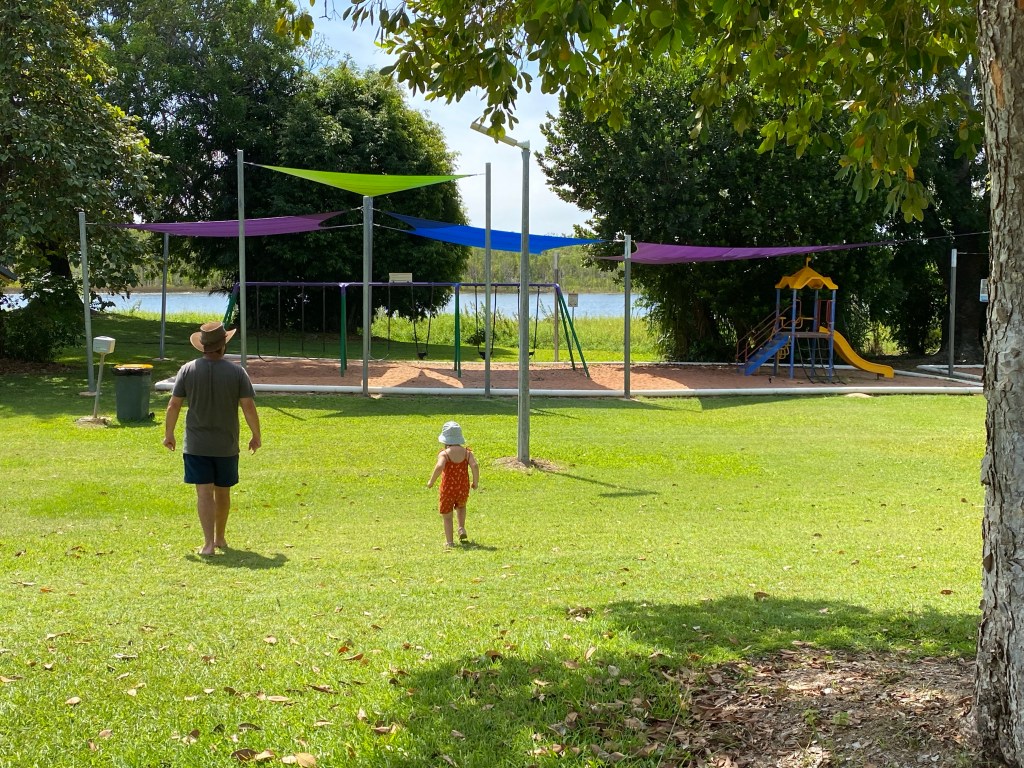
We spent the day relaxing, visiting the local playground and swimming in the freezing cold pool.
Jabiru and Kakadu
Jabiru is the only town within Kakadu National Park.
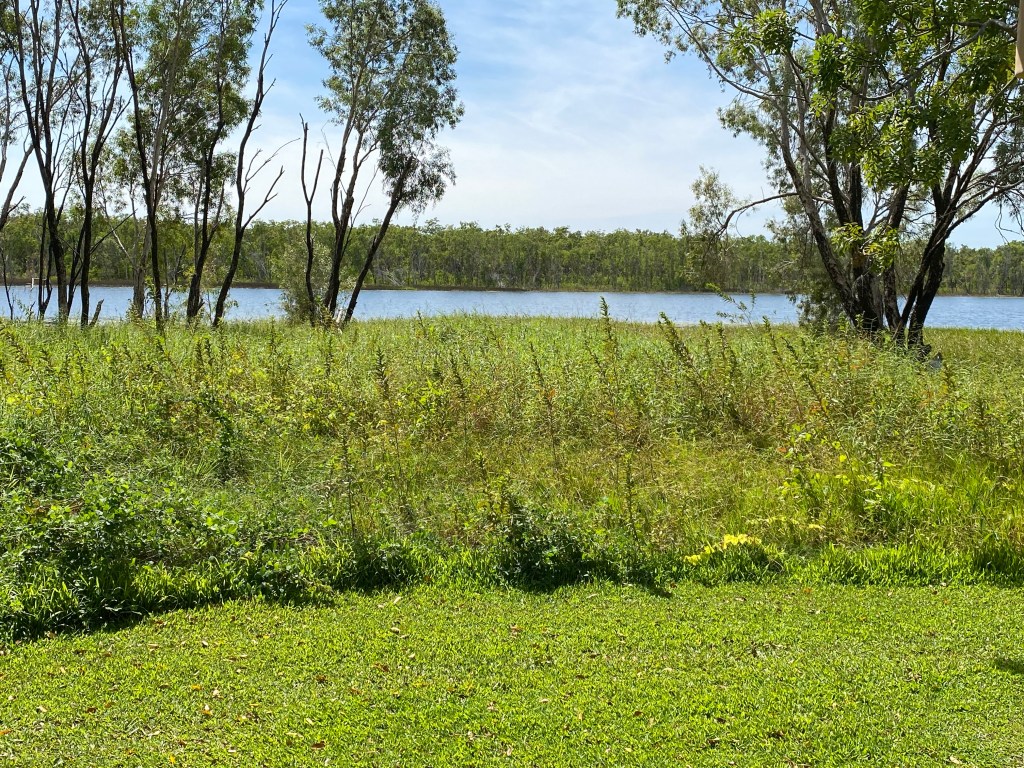
If your only images are those created by the Crocodile Dundee movies and by Northern Territory Tourism promotion then you will be surprised to learn that it is essentially an area of flat tropical savanna woodland with a typical eucalypt monotony produced by a low scrubby vegetation and large tracts of undifferentiated flat terrain.
The reasons Kakadu National Park, which was established as recently as 1979, is so important have more to do with its culture and its remarkable fauna than its physical beauty.
Kakadu can claim to be the site of some of the earliest tropical settlements in Australia and as such is of great archaeological importance. The Aboriginal art galleries, which have been in existence for at least 25,000 years, are an expression of a culture which was more artistically and industrially advanced than its ancient counterparts in Europe and the Middle East.
The local First Nation people had developed grinding stones for crushing seeds and were preparing ochre for painting on cave walls long before Europeans.
Equally the fauna and flora living in the wetlands around the edges of the East and West Alligator Rivers is of international importance. Kakadu contains over 1000 plant species, a quarter of all the freshwater fish species found in Australia, and over one-third of all the bird species.
What’s in a name?
It is believed that “Kakadu” was the generic name given to the First Nation people of the Alligator River region by the anthropologist, Sir Baldwin Spencer. Spencer got his information wrong. Kakadu is the language of the First Nation people who lived in the north western section of the park. As such it probably doesn’t have a specific meaning.
Jabiru, a mining settlement, is named after the First Nation word for a large native bird sometimes known as the black-necked stork or the ‘policeman-bird’.
Jabiru
In 1970 uranium was discovered at Ranger in Arnhem Land. The following year more uranium was discovered at Jabiluka. For the next decade a debate raged over whether the uranium should be mined. In 1975 a Commonwealth Commission of Inquiry into mining at Ranger was established. In 1978 it was agreed that mining could go ahead with substantial royalties being paid to the Northern Land Council. The following year the Northern Land Council approved uranium mining at Jabiluka however the Commonwealth Government was not happy about the situation.
Today only the Ranger Uranium Mine is in operation. The town was created in 1982 to house workers at the Ranger Uranium Mine.
The area is prone to some of the wildest and worst of the weather during “The Wet”. In 2006-2007 it experienced nearly 2000 mm of rain in a three month period and the road to Darwin was cut off for weeks.
History
Prior to the arrival of Europeans (and Chinese and Macassans) the area had been occupied by diverse Aboriginal groups for at least 40,000, and possibly, 60,000 years.
In 1820 Phillip Parker King sailed along the coast and, sighting the three Alligator Rivers, he named them incorrectly when he mistook the crocodiles for alligators.
In 1845, on his epic journey from Queensland to Port Essington, Ludwig Leichhardt crossed both the South and East Alligator Rivers.
By the 1880s the wild buffalo in the area were being hunted for their hides.
By the 1910s there was a sawmill, run by Chinese, processing local cypress pine near Nourlangie.
By 1912 the anthropologist, Walter Baldwin Spencer, had visited the area.
In 1925 a mission to the local Aborigines was established by the Church of England at Oenpelli.
Another anthropologist, N. B. Tindale, travelled through the area in 1928.
In 1948 the American-Australian Scientific Expedition to Arnhem Land was established.
By 1971 saltwater crocodiles were protected throughout the Northern Territory.
On 5 April 1979, as part of the Commonwealth Commission of Inquiry into the Ranger Mining Proposals, 6000 sq. km of Arnhem Land was set aside for a park under the National Parks and Wildlife Act.
Kakadu gained international publicity when it featured prominently in the two Crocodile Dundee movies.
In 1989 Kakadu National Park management board became predominantly Aboriginal.
The town was formally handed over to the Mirrar people on 16 June 2021.
Tomorrow
We go to Cahills Crossing.

 morrisblog.travel.blog